
A Lectern of Significance, a Sacred Taonga
by Pene Clifford - St Joseph the Worker, Lyttelton
In Christian tradition, the lectern from which the Word of God is proclaimed is frequently constructed in the form of an eagle. The symbolism of this comes from the four creatures around the throne of God, spoken in the prophecy of Ezekiel in the Old Testament and found in developed form in the Book of Revelation in the New Testament.
Christian tradition has come to associate these creatures with the four evangelists. Each of the writers of the Gospel has his particular message regarding the character of the Saviour and each message is appropriately symbolised by one of the four creatures. While all the evangelists share in the proclamation
of the Gospel, John’s Gospel and its message is one of the most frequently expressed in sculptured form in lecterns. John is the eagle. He is the one who soars and is taken into the sun to proclaim the Gospel.
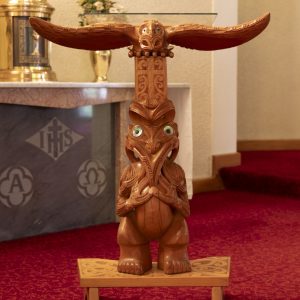
In the St Joseph’s lectern, this Christian symbolism is expressed in Māori artistic form. The impetus for the commissioning of this lectern came from a clergy seminar on the Treaty of Waitangi in early 1990. Fr Durning, an experienced chaplain of the Māori people, suggested that there should be something in every church with which Māori could identify.
At that time, Fr Pat Kearney CSSR, was the superior of the Redemptorist community, ministering in the church of the Most Holy Redeemer at North New Brighton. He approached Riki Manuel, a renowned and respected local carver and artist, and asked him to carve a lectern for their chapel. It was a 1990 project, commemorating the Sesquicentennial year of Aotearoa / New Zealand.
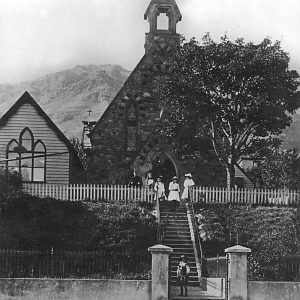
The unveiling of the lectern took place in May 1991, during the Saturday Novena. Members of the Catholic Māori Community of Te Rangimarie attended the blessing of the lectern. With the closing of the chapel, the lectern was gifted to the church of St Joseph the Worker, Lyttelton, in 2001. It was the lectern for the church until it was destroyed by the 2010 and 2011 earthquakes. This special lectern was then used regularly in the chapel in the Lyttelton presbytery, until St Joseph the Worker parish was closed at Pentecost 2021, becoming part of Stella Maris Parish of Christchurch East. With karakia, the lectern was welcomed into St Anne’s church, as a symbol of connection for the St Joseph the Worker parish.
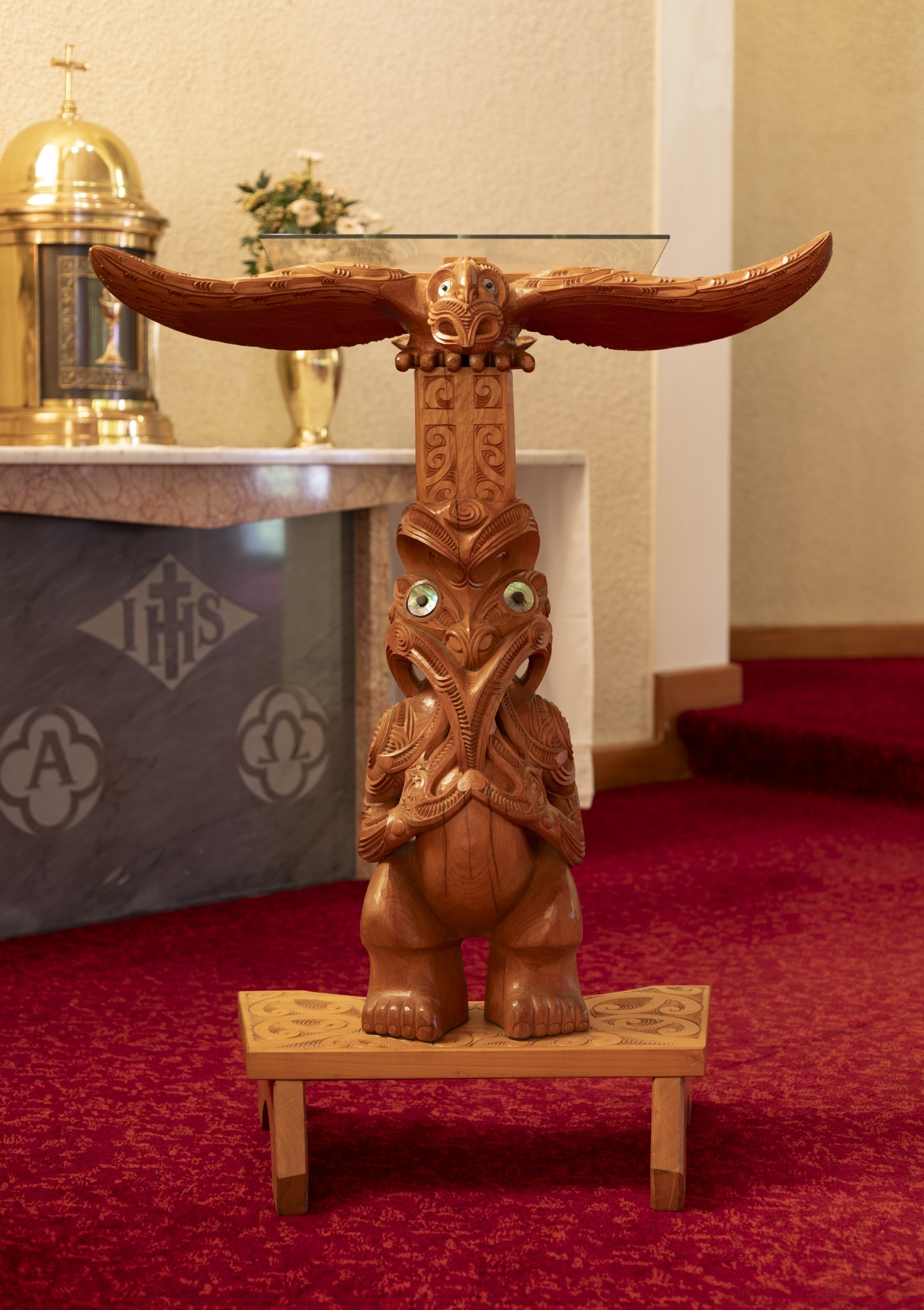
This beautiful lectern is carved from Kauri timber, once part of the New Brighton pier. The scale and proportion of the work provide a fitting place for the proclamation of the Word during liturgical worship.
Māori meeting houses, wharenui, generally contain an abundance of carved figures and woven patterns. These are a potent means of expression and storytelling for a people with no written language.
The carved eagle representing St John the Evangelist is the New Zealand Haast eagle, the Pouakai. Now extinct, this was the largest eagle in the world. This gigantic bird had talons as big as a tiger’s claws and may have lived until 500-700 years ago, in the forests of the South Island. With a wingspan of up to three metres, the female weighed as much as thirteen kilograms, much bigger than the largest eagle in the world today.
Below the eagle, the symbols representing the three other evangelists are carved in relief on the front and sides of the column supporting the lectern. The lower part of the column is carved with a tekoteko figure. This is often found at the apex of the wharenui. At other times, this figure is at the base of the verandah pole. The lectern follows the latter tradition. The figure is carved in a prayerful posture, that symbolises our trusting relationship with our Creator.
The pedestal on which the figure stands, is carved with the kawe o te hue pattern. This depicts the fronds of the gourd, used in reciting the whakapapa, the genealogy of the family tree. Māori tradition places great importance on the genealogy of the ancestors, the previous generations — the family tree. This is also found in Jewish tradition and continued in the Gospels. In the first chapter of his Gospel, St Matthew provides a list of the ancestors of Jesus, from Abraham, our father in faith. By our common Baptism, Christians are all part of the family of God, with one Lord, one faith, one Baptism. We all breathe the same Wairua Tapu, breath of the Holy Spirit passing through us. Here, as elsewhere in the work, Māori spirituality, formed and informed by the Gospel, flow together as one.