


History of the Cathedral of the Blessed Sacrament
The Catholic Diocese of Christchurch was established by papal brief on 5 May 1887 and John Joseph Grimes SM was appointed bishop to the new See. Within a few years, Bishop Grimes “had the idea of devoting [his] energies…to the building of a suitable temple for the worship of God”1 . He received his first donation, from local priest Fr Foley, for “the noble work”2 of a Cathedral Fund. And later, following an Ad Limina visit to Rome, +Grimes credits Pope Leo XIII as “the prime mover in forwarding the work of the cathedral”. Encouraged by the Pope’s support, Bishop Grimes sought donations wherever he went in Europe and America.
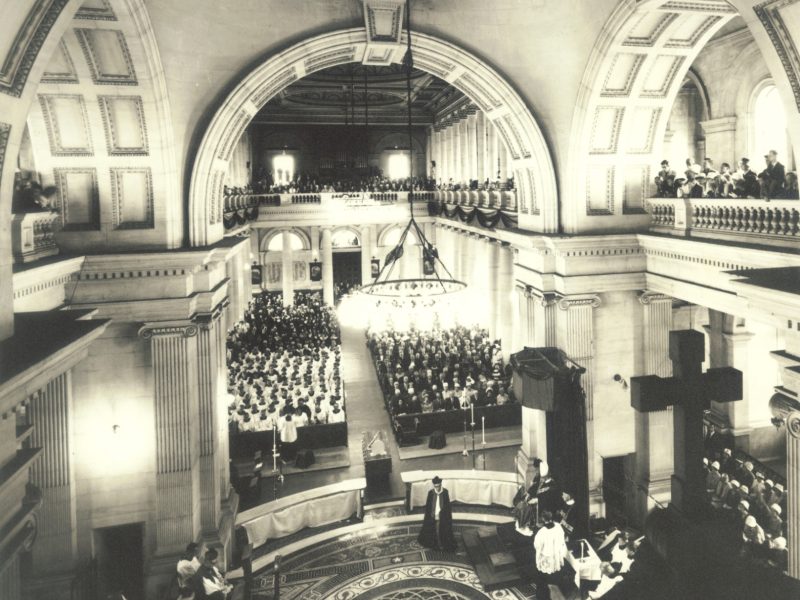
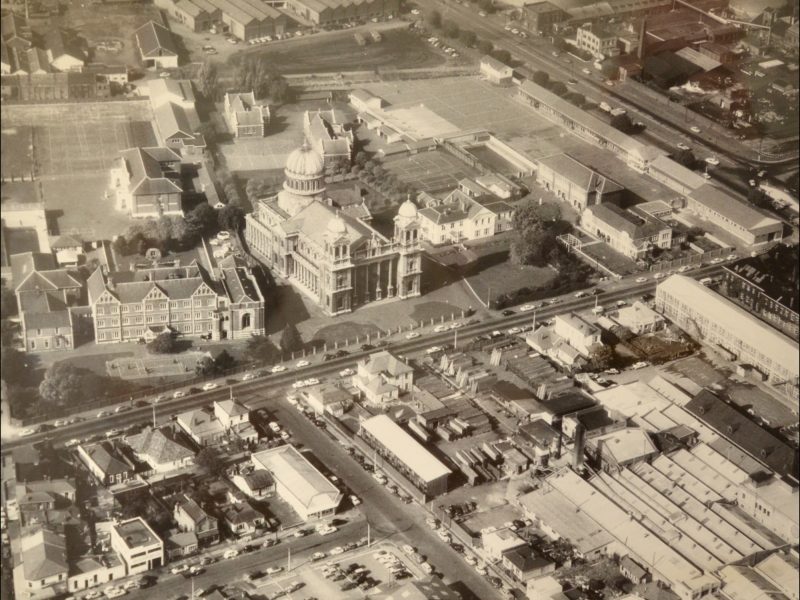
On his return to Christchurch he had raised £3,000 in total. Although initially favoring a Gothic style building, to rival the Anglican Cathedral, Bishop Grimes was persuaded by architect Francis Petre to give up the gothic design in favour of a basilica. Francis Petre, was contracted to design the Cathedral. He had previous experience in using concrete, and this allowed him to utilize innovative methods during construction such as pouring walls of concrete, then sheathed with stone. The Cathedral was built by Jamieson and Sons who had built other ecclesiastical and municipal buildings through New Zealand.
Their skill and innovation was partly responsible for the relatively short construction timeframe for the Cathedral. Fifty men were employed on the site, and in excess of 3,400 cubic metres of stone, 110m³ of concrete, and 90 tons of steel were used in the construction. Many issues arose while the Cathedral was being built, including the structure’s subsidence in the soft ground, increasing costs especially in the supply of suitable limestone from Oamaru, and the prices of zinc and steel for coatings. With subscriptions and donations struggling to offset the increased costs, the Cathedral building was nearly abandoned in 1903. New Zealand Premier, Richard John Seddon, promoted a bill through Parliament that allowed the diocese to raise a loan for £20,000, thus securing the funds to finish construction.
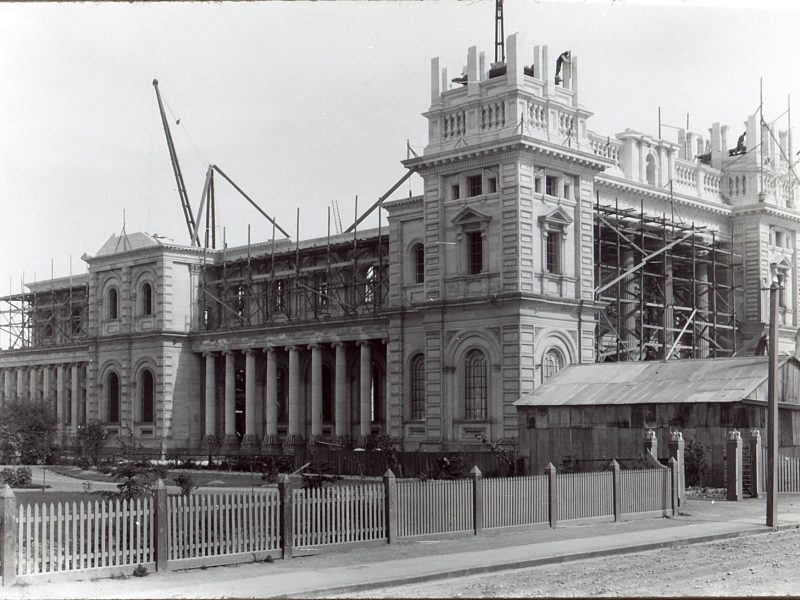
The Cathedral of the Blessed Sacrament was opened and dedicated on 12 February 1905, with much pomp and ceremony. It had cost just over £52,213 and left the diocese with a debt of £20,483. Subsequent decades of neglect resulted in a major project to restore the Cathedral and reorder the interior, which took place in the 1960s/70s. Earthquake strengthening work was completed in 2004. The 7.1 earthquake on 4 September 2010, resulted in damage and the closure of the Cathedral to the public, to allow for further strengthening and repair. The earthquake on 22 February 2011, however, caused significant damage to the building. The two bell towers at the front of the building collapsed, bringing much of the front facade down with them. Risk to neighboring properties subsequently resulted in the dome being removed. Though the temple was no longer suitable, on the remaining facade Bishop Grimes’ inscription remains: Ecce Tabernaculum Dei Cum Hominibus - Here God dwells among his people.
1 The Press, 11 February 1905
2 Bishop Grimes’ 1899 Pastoral Letter
You will have just read the brief history of our Cathedral of the Blessed Sacrament in Barbadoes Street. It is a reminder of the faith and vision of our forebears and their desire to have a sacred place for prayer and witness to belief in God and the Good News of Jesus Christ for all humankind. We were very blessed to have had this holy place for so long. The decision to deconstruct this Cathedral was a sad one to make as the Bishop. So much of our faith history and experience as a diocese was centred there. Like all our churches they become lined with the prayers of so many holy people who gather to praise God and to receive the Sacraments. It is why we take our churches seriously and treat them as holy places. I want to reassure you that when we build a new Cathedral it too will be a place that has a beauty which lifts our hearts to God. It will be a place for prayer and we will line it with our prayers and presence at the Eucharist and other liturgies that will take place there. We will make it our home and also a witness to the people of Christchurch of the presence of Christ’s followers in the city and beyond. I want our Cathedral to be a place where people gather constantly for prayer and that in the surrounding facilities for many other activities that lead to the build up of the faith of the people and also outreach to those seeking Christ or in other sorts of need. This is our time now to build for future generations, just as our forebears did. The original building cost £52,000 which is the equivalent of $50 million today; it was a huge undertaking. We too will need to undertake something of a similar nature if we are to do justice to our faith and to build something that will meets the needs of now and the future. Let us be generous in our thoughts, prayers and finances as we continue our life and witness as Catholic people in our diocese of Christchurch.
Bishop Paul Martin


