
Towards an Acts 2 Priesthood

“I dream of a “missionary option”, that is, a missionary impulse capable of transforming everything, so that the Church’s customs, ways of doing things, times and schedules, language and structures can be suitably channelled for the evangelisation of today’s world rather than for her self-preservation.”
Pope Francis, Evangelii Gaudium, 27.
We don’t have a shortage of priests! This statement might sound surprising. After all, in 1970 we had 138 priests ministering in our diocese and 50 years later we had just 62. Furthermore, we have seen a dramatic decline in the number of parishes (from 50 to 18) in just the last 15 years. The priests we know are stretched more widely and there are fewer young men entering the seminary than in the past.
But, I still maintain, we don’t have a priest shortage. We have plenty of priests. According to the latest annual report of the Catholic Diocese of Christchurch, we have 63,000 baptised Catholics in our diocese. This means we have 63,000 priests! Sure, the number of men in Holy Orders is over half it was 50 years ago. But the number of Catholics has stayed remarkably consistent, hovering just over 60,000 people. So we have plenty of priests. They are just a different kind than what we are used to.
The question then naturally arises: what might the Lord be saying to us through these numbers? To be sure, the decline of the number of men in Holy Orders is worth noting. But God could give us more priests if He wanted to! It’s not for a lack of prayer. We have had various beautiful initiatives such as the Year for Priests from 2009 - 2010 and praying intentionally for vocations on Thursdays throughout the year. So what might God be saying to us at this time?
One of the many unrealised fruits of the Second Vatican Council is the understanding of the vocation of the laity. Unfortunately, the lay vocation has often been understood in a negative sense, in other words, what lay people are not. Lay people are, by definition, not ordained men or those who have taken religious vows. The documents of Vatican II and various popes since then have beautifully outlined the lay vocation in a positive sense. Here is how the most important Vatican II document describes the lay vocation:
“But the laity, by their very vocation, seek the kingdom of God by engaging in temporal affairs and by ordering them according to the plan of God. They live in the world, that is, in each and in all of the secular professions and occupations. They live in the ordinary circumstances of family and social life, from which the very web of their existence is woven. They are called there by God that by exercising their proper function and led by the spirit of the Gospel they may work for the sanctification of the world from within as a leaven. In this way they may make Christ known to others, especially by the testimony of a life resplendent in faith, hope and charity.” Vatican II, Lumen gentium, 31.
Despite this theological clarity, unfortunately we still have an impoverished understanding of the role of the laity in the Church. To be sure, there are many competent lay people in our parishes who are engaged in governance, administration and pastoral care. We are deeply grateful for them. But lurking beneath this reality is a subtle kind of clericalism that goes something like this: in order to be a serious Catholic one needs to be involved with the structures, ministries or groups of the parish. This mentality is unhelpful, even dangerous, because it runs the risk of alienating 99% of people without, whom St. John Henry Newman reminds us, the Church would look very foolish! Pope Francis puts it this way:
“Lay people are, put simply, the vast majority of the people of God. The minority – ordained ministers – are at their service. There has been a growing awareness of the identity and mission of the laity in the Church. We can count on many lay persons, although still not nearly enough, who have a deeply-rooted sense of community and great fidelity to the tasks of charity, catechesis and the celebration of the faith. At the same time, a clear awareness of this responsibility of the laity, grounded in their baptism and confirmation, does not appear in the same way in all places. In some cases, it is because lay persons have not been given the formation needed to take on important responsibilities. In others, it is because in their particular Churches room has not been made for them to speak and to act, due to an excessive clericalism which keeps them away from decision-making. Even if many are now involved in the lay ministries, this involvement is not reflected in a greater penetration of Christian values in the social, political and economic sectors. It often remains tied to tasks within the Church, without a real commitment to applying the Gospel to the transformation of society. The formation of the laity and the evangelization of professional and intellectual life represent a significant pastoral challenge.” Pope Francis, Evangelii Gaudium, 102.
In many ways, the diocesan priesthood is still understood in a “Christendom” mentality, despite superficial changes in structures and practices. This understanding of the diocesan priesthood tends to emphasise the external and the functionary - the visible structures, ministries and programs that the priest is responsible for. Diocesan priesthood then becomes about crafting mission statements (which are eerily similar to those of other parishes), facilitating programs that try to funnel lay people through predetermined “discipleship pathways” and trying shoehorn people into the preexisting ministries, programs and structures of the parish. Unintentionally, we can end up alienating the very people we were ordained to serve!
Take Tim. Tim is a priest (and he is married!). Tim is aged in his early thirties and has two children under five. Tim is an in-house lawyer for a government department, handling a number of complex legal contracts between the government and private providers. Chris rises early every day for 30 minutes of personal prayer before getting ready for work. On his commute to work, Tim will pray the Rosary, the Divine Mercy Chaplet or listen to a Catholic podcast. He will stop by the local church (if it is open!) on his way to and from work. As well as spending time with his wife and children, Tim enjoys working
out at the gym, playing golf and simply relaxing with his family. Tim doesn’t have the time or the interest to be involved in parish groups, ministries or programs. Instead, Tim needs formation and accompaniment that is specifically calibrated to his particular way of life. He needs a priest who can guide him about the specific contracts that he is negotiating to ensure that they align with Catholic Social Teaching. Tim needs advice on how to relate with a LGBT co-worker who seems hostile to a Christian in the workplace, whether to purchase a new house for his expanding family and which school to send his children to. This is Tim’s domain, his sphere of influence, where he exercises his priesthood. Tim might spend 90 minutes in a church or on parish grounds throughout the week, yet he is very much a priest.
Or take Amber. Amber is a priest too (and, yes, she’s a woman!) Amber is late thirties, single and a registered nurse in the busiest Emergency Department in the country. Amber works shiftwork, sometimes back-to-back, in order to send some of her wages overseas to her family. She rents two rooms in the house that she owns to help pay the mortgage and to provide support to people who are studying. Outside of work, Amber is a babysitter and a godmother to her nephew, a role that she takes seriously. She also enjoys tramping and exploring the New Zealand outdoors. Once again, Amber does not have the time or the ability to be involved with ministries, groups or programs in the parish. Amber often even struggles to make Sunday Mass and frequently needs to be dispensed from this obligation and have it commuted to another day instead. Amber needs formation about how to maintain a consistent prayer life amidst shift work. She needs formation and advice about how she can see the people she cares for as Christ, despite them being drunk, abusive or obnoxious. She needs someone to consult about situations like whether or not to turn off life support for a patient or how to manage priorities when the shift is short-staffed. She needs guidance on the appropriate level of support that she can give her elderly parents in the Philippines whilst maintaining her commitments to her family and friends here in New Zealand. Amber needs formation specific to her situation. Her mission field is her housemates, her family, the nursing ward, the tramping hut. Further, Amber often needs support and advice at inconvenient times like nights and weekends, when others have gone to bed or are relaxing. Amber too is a priest, despite spending very little time in the parish institutions, ministries or groups.
I use these two examples because they highlight the unrealised potential that lies at the heart of our Church today. The primary mission field for the lay faithful is in their day-to-day activities in the world. This mission field was outlined by Vatican II:
“The laity must take up the renewal of the temporal order as their own special obligation. Led by the light of the Gospel and the mind of the Church and motivated by Christian charity, they must act directly and in a definite way in the temporal sphere…. Everywhere and in all things they must seek the justice of God's kingdom. The temporal order must be renewed in such a way that, without detriment to its own proper laws, it may be brought into conformity with the higher principles of the Christian life and adapted to the shifting circumstances of time, place, and peoples.” Vatican II, Apostolicam actuositatem, 5.
Fundamentally, the role of the diocesan priest (and the parish) is to accompany and support our baptised priests so that they can exercise their priesthood by renewing the temporal order. This is the dramatic shift of the diocesan priesthood compared to 50 years ago, when the role of the priest was to sustain the social life of the parish and the devotional life of the faithful. This is not sexy and doesn’t have instant or even observable results. It involves sleepless nights, inconvenient timings and inherent messiness. People and pastoral care do not necessarily fit into neat boxes or predetermined outcomes! By its very nature, it is limited to a few people who are accompanied and formed intensively at first and then who, after a period of time, are able to accompany others. This is not something that can be achieved by structures, buildings, techniques, mission statements or pastoral plans!
This means that the diocesan priest is not primarily responsible for programs and initiatives, structures and bureaucracy, necessary and as important as they are. Fundamentally, the priest is about service and is called to see everything that he says and does in light of support of the baptised, who are also priests. Pope Francis captured this nicely when he wrote:
“Parishes, beginning with their structures and the organization of parish life, are called to think of themselves “primarily as being of service to the mission that the faithful carry out in society, in family life and the workplace, without concentrating exclusively on their own activities and their organizational needs.” Pope Francis, Letter to Parish Priests, 2 May 2024.
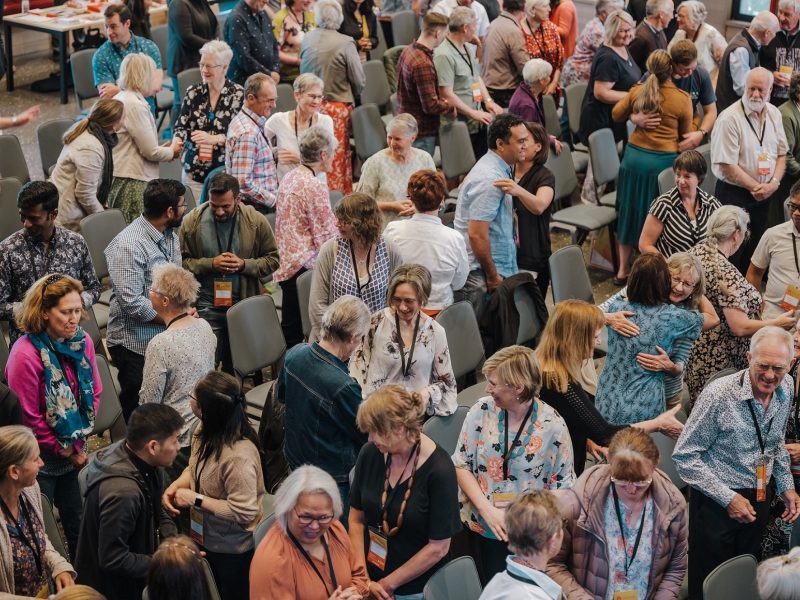
We have plenty of priests in our diocese – over 60,000 of them! We need to better understand and support the priesthood of the baptised so that we can, in turn, understand the ministerial priesthood with more clarity. If we don’t, we risk plugging our new models of parish renewal into old structures, albeit on a bigger scale, with the appearance of success but very little change deep down. We need diocesan priests who can lead, accompany and form our baptised priests so that they can do what they meant to do – order the temporal affairs according to the plan of God. It is my hope as Vocations Director that we may come to understand the role of the diocesan priest not as one informed by “Christendom” but as one of service to baptised priests like Tim and Amber. Only then will we be truly missionary, capable of transforming our world and our society with the power of the Gospel.
Fr. Monty Bamford
Vocations Director – Catholic Diocese of Christchurch
“Good Shepherd Sunday” - 26 April 2026